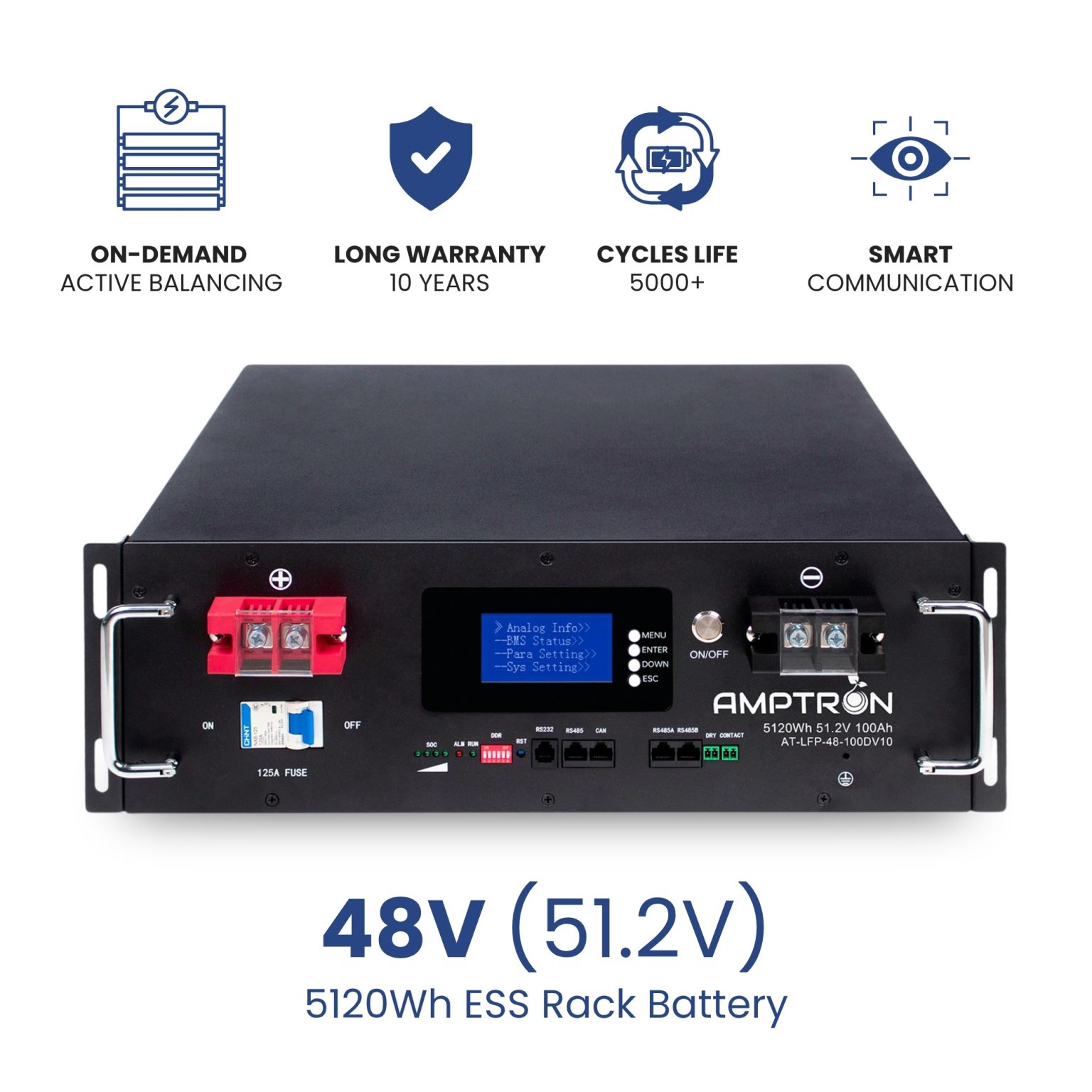
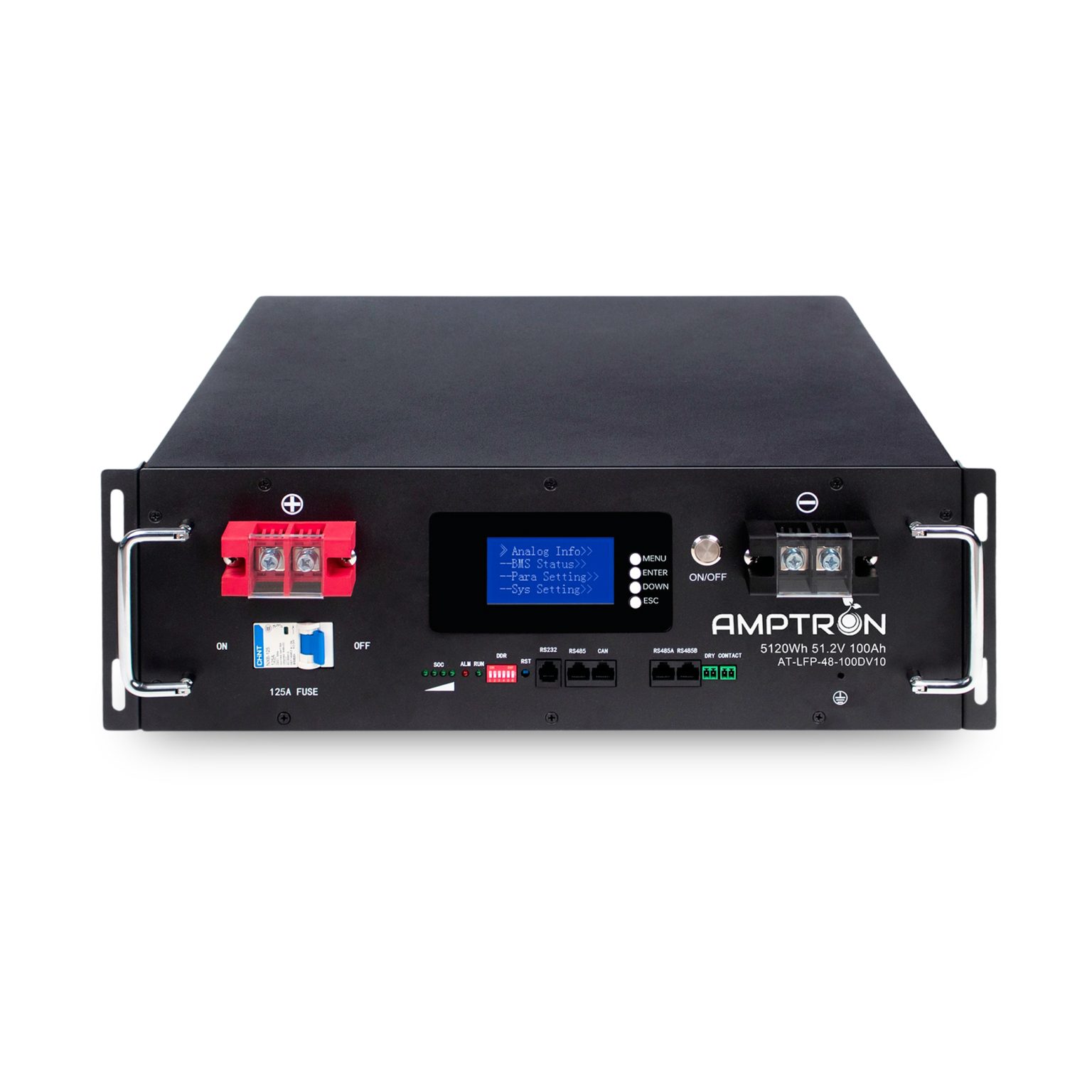
48V (51.2V) 100Ah 5120Wh LiFePO4 Rack Battery with Active Dynamic Balancing,10 Years Warranty, 5000+ cycles life
$3,799.00
including GST
The 51.2V 100Ah Lithium Iron Phosphate battery system is a high-tech product developed for the Australian market, both on and off grid. The battery pack adopts a robust internal structure, advanced BMS system, and industry-leading production technology. With the characteristics of long life, safety, reliability, and wide operating temperature range, it is an ideal product for stored energy connected to solar systems.
This battery is fitted with an on-demand active balance system which maintains battery health for the full product lifecycle.
*New Product 2025
If you have any questions about stock quantities, please contact us before ordering.
Found this product cheaper elsewhere? We offer price matching. T&C’s apply.
INFORMATION
Description
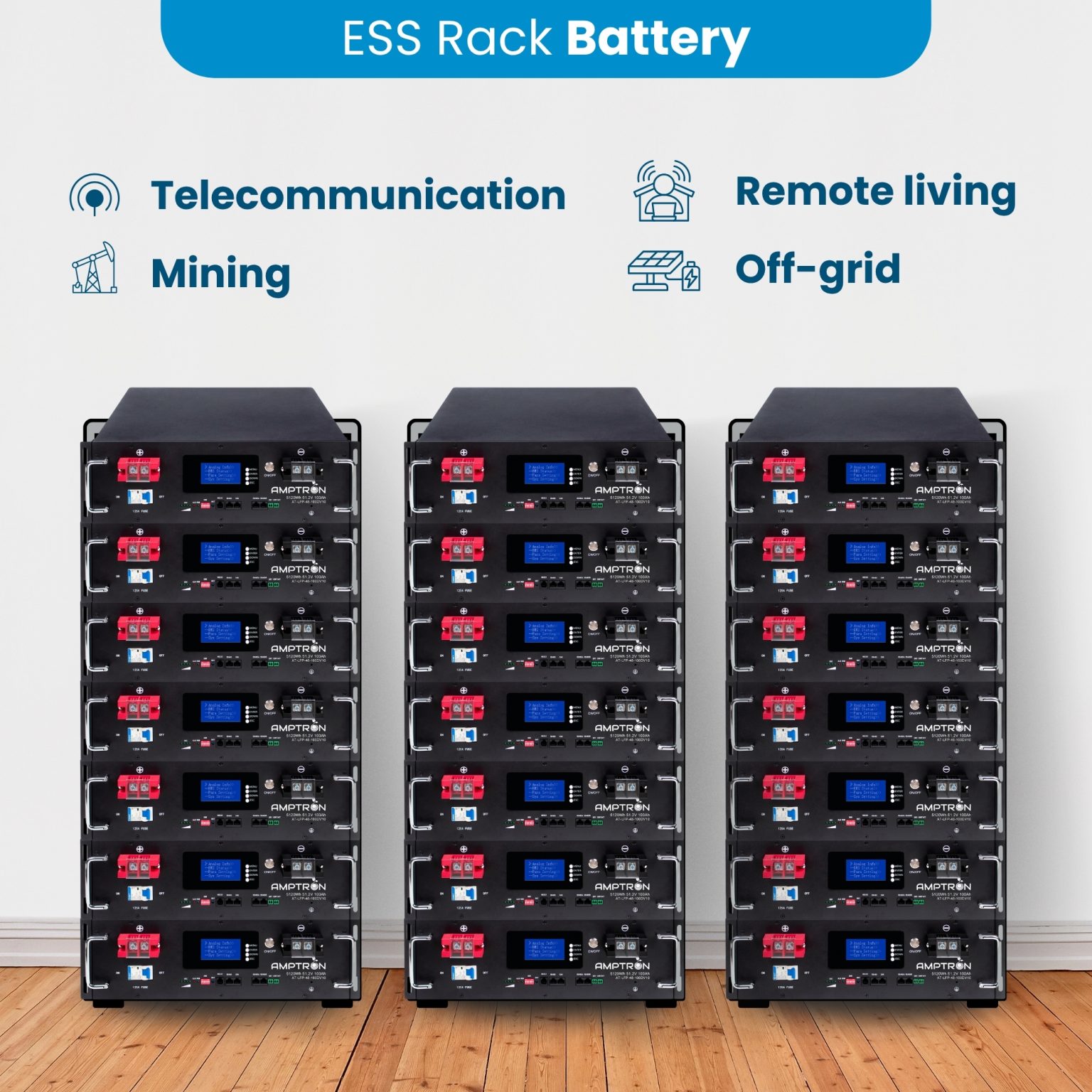
This Amptron® ESS series battery adopts a robust internal structure, advanced BMS system and industry-leading production technology. With the characteristics of long life, safety, reliability, and wide operating temperature range, it is an ideal product for stored energy connected to solar systems typically seen industries such as telecommunications, mining and Off-Grid / remote living.
The battery is fitted with an on-demand active balancing system (Dynamic Active Balancing) which maintains battery health for the full product lifecycle. The active balancing operates in unison with the passive balancing and offers between-cell balancing of up to 2A which is automatically triggered when the Delta V (difference between highest cell group and lowest) surpasses a certain threshold. This can be a particularly useful feature to maintain full capacity on a battery pack in the later stages of a cell aging, while not unnecessarily operating continuously which could otherwise lead to accelerated wear of the battery cells.
Battery Features
Key Parameters that are Communicated:
Total battery string voltage, battery string capacity (SOC), battery string health status (SOH), battery voltage, battery strings, charging /discharging current, and number of battery string cycles (If the discharge exceeds 80% of the nominal capacity, the value is 1 Cycle), cumulative discharge capacity, maximum and minimum battery voltage, ambient/battery string temperature (four battery cell temperatures, one ambient temperature, and one MOSFET temperature), historical data.
Alarms and Protection Status’:
Protection function status, battery string charging/discharging status, total battery string high voltage alarm, total battery string low voltage alarm, Battery overvoltage alarm, battery undervoltage alarm, battery string short circuit alarm, battery string overvoltage/overcurrent alarm, battery string undervoltage/overcurrent alarm, battery string low capacity alarm, battery string polarity reverse connection alarm, battery high/low temperature alarm, ambient high/low temperature alarm, MOSFET temperature alarm, battery string low capacity alarm, and cell failure alarm.
Remote control:
Protection function status, alarm sound on/off, intelligent intermittent charging mode, current limiting charging mode, charging on/off, discharge start/stop, etc.
Various other functional states and parameter setting range, BMS and switching power, system output performance and matching parameters.
Other Functions and ControlsReset button
- When the BMS is in a dormant state, press the button for 1 second and then release it. The protection board will be activated, and the LED indicator lights will start from “L4” for 0.5 seconds.
- When the BMS is in an active state, press the button for 3 seconds and then release it. The protection board is dormant, and the LED indicator lights will turn on for 0.5 seconds from “RUN”.
Buzzer Action Description
- When a fault occurs, the sound is 0.25 seconds every 1S.
- When the BMS is protecting, a chirp will sound for 0.25S every 2S (except for overvoltage protection).
- When an alarm is generated, the alarm buzzes for 0.25S every 3S (except for the overvoltage alarm at end of charging cycle). The buzzer function can be enabled or disabled by via the computer interface, but is disabled by factory default.
Sleep function
When any of the following conditions are met, the system enters the low-power mode:
- Cell or overall over-discharge protection is not removed within 30 minutes.
- The minimum cell voltage is lower than the hibernation voltage of 3300mV, and the duration reaches the hibernation delay (The default value is 500 seconds. No communication or current is required).
- Standby time exceeds 1 hour (0.5 to 2 hours can be configured) (no communication, no charge / discharge, and no charger is connected).
Before hibernation, ensure that no external voltage is connected to the input terminal, no external communication is available, and the on / off button is not pressed. Otherwise, the low-power mode cannot be entered.
When the voltage of any unit is lower than the undervoltage protection value of 500mV, the BMS will enter the ultra-low voltage sleep after 1 min.
Shipping & Delivery
We ship Australia wide direct to your door.
Order online today and we will dispatch your products within 1-2 business days.
We will send tracking to you.
Specifications
Detailed information and noted points:
|
Item
|
Specification
|
Description/Remark
|
|
Model
|
AT-LFP-48-100DV10
|
48V 100Ah / 100A LiFePO4 rack mounted battery with data comms
|
|
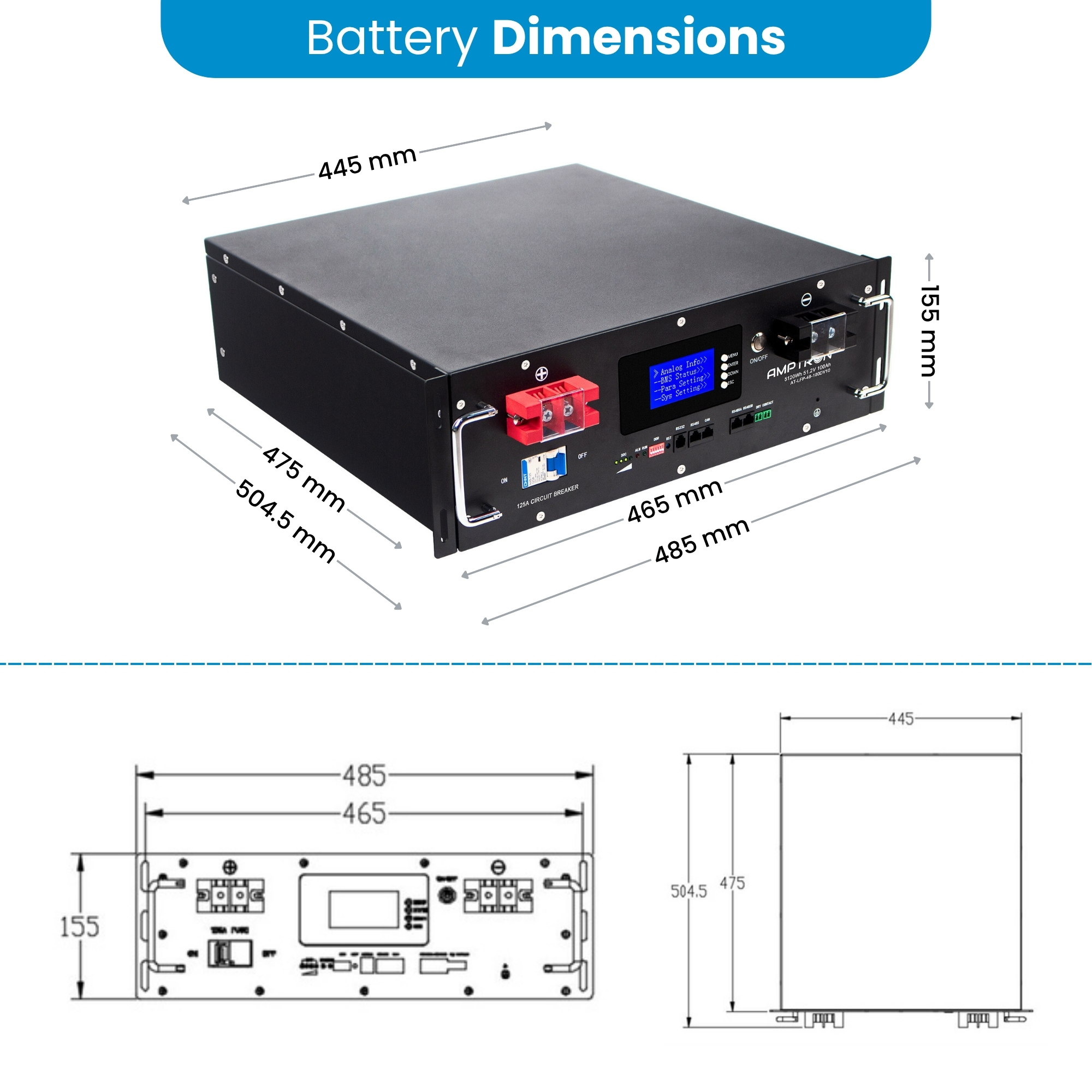
Size
|
L-460mm x W-473mm x H-155mm |
Including tabs: 485x505x155mm
|
|
Weight
|
46 kg
|
|
| Nominal Voltage (V) | 51.2V | |
| Nominal Capacity | 5120 Wh | |
| Nominal Capacity (kWh) | 5.12kWh | |
| Charge Voltage | 58.4V | |
| Warranty | 10 Years | Design life 15 Years |
| Battery cycle life | 6000 times | |
| Charging Voltage | DC 58.4V | |
| Operating Voltage Range | 40V-58.4V | |
| Continuous Charge Current | 100A | |
| Continuous Discharge Current | 100A | |
|
Internal Resistance
|
≤ 20 mΩ
|
|
| Operating Temperature | -10°C-55°C | |
| Storage Temperature | 0°C-55°C | |
| BMS PARAMETERS | ||
| Self Consumption | ≤ 2.5W | |
| Rated Voltage (V) | 51.2V | |
| Balance Current | 30-65 (MA) | |
| Current Limiting | 10A/20A(Optional) | |
| Communication | CAN / RS485 / RS232 (Optional) | |
| Information Storage | 500 strip | |
| Operating Temperature | -10°C – 55°C | |
| Storage Temperature | 0°C – 55°C | |
| Humidity | 15%-75% | |
| Supported Inverter Protocols | Deye, Goodwe, Growatt, Pylontech, SMA, Sol-Ark, SRNE, TBB Power, Victron Energy, Voltronic, Bluesun |
SKU or Product Number
AT-LFP-48-100DV10
Categories 48 VOLT Batteries, Batteries, Continuous Discharge LiFePO4, Uncategorized
Related Products
Related products
-
Driving Light Accessories
Nitro Maxx Light Bar Brackets to suit Rhino Pioneer Platform (below rack)
$114.00 Add to cart